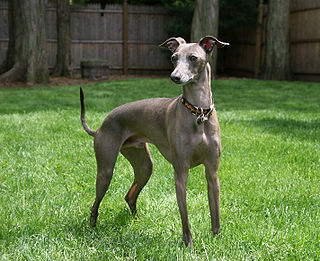
Denominación: PICCOLO LEVRIERO ITALIANO (Italian Greyhound)
Sinonimia: No synonyms are mentioned in the official standard.
Orígenes y difusión de la raza
Orígenes y difusión de la raza: The Italian Greyhound descends from a small-sized sighthound that already existed in ancient Egypt at the court of the pharaohs. Numerous representations on vases and vessels attest to its presence in Laconia (Greece). The breed arrived in Italy at the beginning of the fifth century BC. Its greatest development occurred during the Renaissance at the court of the nobles. It is not uncommon to find the Italian Greyhound depicted in paintings by great Italian and foreign masters.
Apariencia general y carácter
Descripción de conjunto: Of slender appearance, its body fits into a square. Although small in size, it is fully characterized as a miniature sighthound, the prototype of refinement and elegance. It can be considered a model of elegance and distinction.
Carácter y aptitud: Cheerful, affectionate, and docile.
Morfología externa
Altura a los hombros: Males and females: 32 to 38 cm.
Peso: Males and females: maximum 5 kg.
Cabeza: Long and narrow.
Cráneo: Flat with parallel upper axes of the skull and muzzle. The length of the skull is equal to half the length of the head, which has slightly rounded sides. The lower orbital region is well chiselled. The muscles of the head should not show any heavy aspect. Eyebrow bones are marked. Occiput not prominent. Slightly marked median depression. Nasal-frontal depression (stop) very slightly marked.
Nariz: Dark in color, preferably black with well-opened nostrils. Muzzle: Narrow. Lips: Thin and tight, with very dark edges. Jaws/Teeth: Elongated jaws with well-aligned incisors in a circle, strong relative to the size of the dog. Healthy and complete teeth, set at a right angle in the jaws, with a scissor bite. Cheeks: Lean.