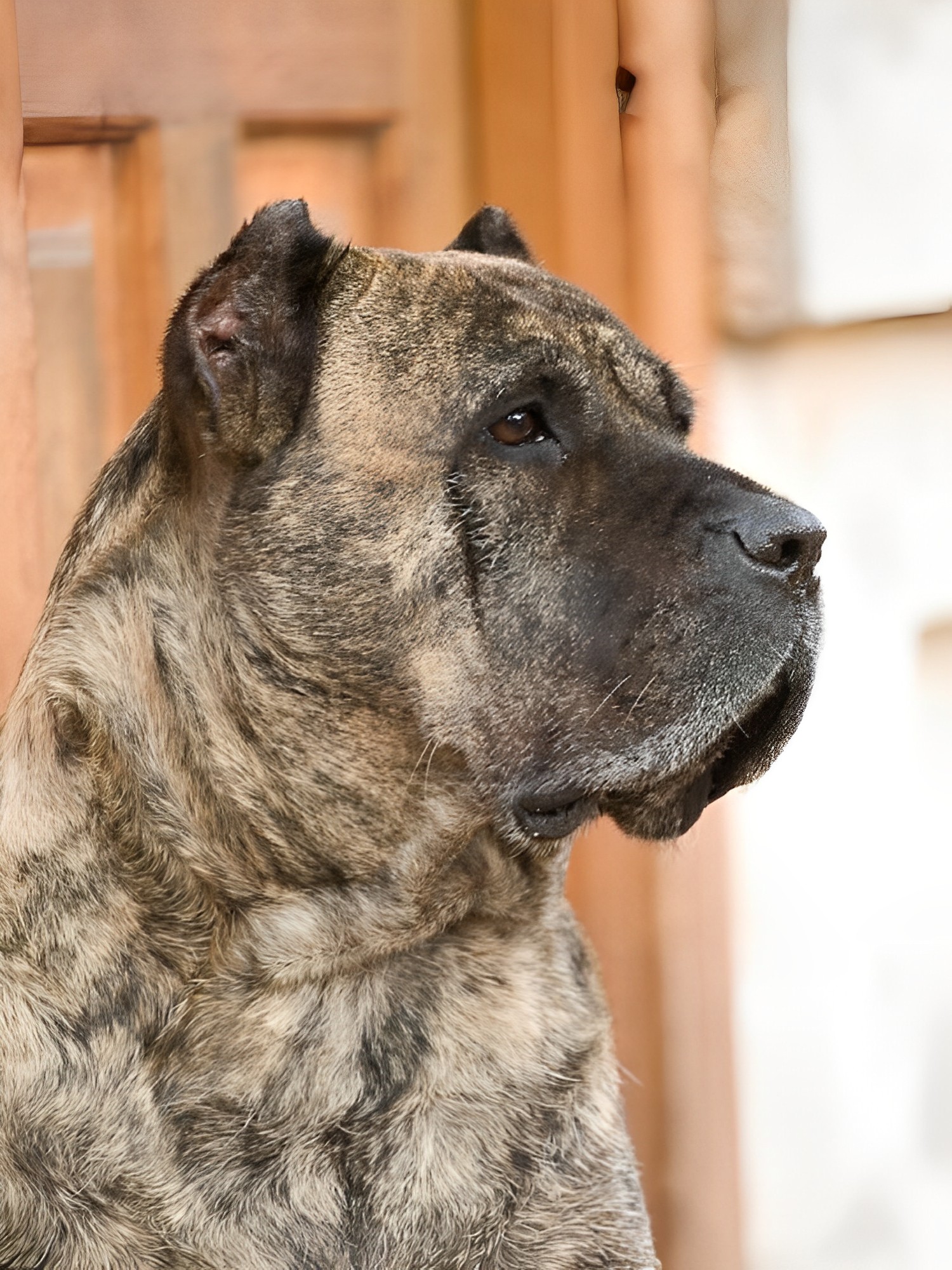
Sinonimia: In Tenerife it is also often called “Perro Basto”, or “Berdino”, for those specimens with a brindle coat (atigrado).
Orígenes y difusión de la raza
Orígenes y difusión de la raza: Molossian dog originating from the Canary Islands. In the Agreements of the Cabildo de Tenerife, in the Ordinances of Tenerife, and in the Agreements of the Cabildo de Fuerteventura, from the 16th century, there is talk, among other canine breeds, of presa dogs. The most logical thing is to think that this dog was introduced in the Canary Islands by the Spanish conquerors and settlers. Then, with time and isolation, it could lead to a completely different race. It is also possible to think about the possibility that, due to the influence of other presa dogs brought from other parts, its typology was modified to some extent. The truth is that this hunting dog, with a voluminous body and head, somewhat lymphatic, and of an extraordinary temperament, was used in the Canary Archipelago to guard farms, to care for cattle and as a butcher’s assistant in the sacrifice of cattle.
In its evolution, from the end of the 19th century, what we could consider the modern presa dog, is outlined from the racial point of view, with the influence of the Perro de Ganado Majorero, or Bardino Majorero, which is what gives it that characteristic so peculiar that makes the Perro de Presa Canario differ from the other molossoid breeds. In recent decades it has been frequently used as a combat dog. The incessant work of breeding has ensured that the Presa Canario is widely distributed and today it is bred and selected with the concept of breed that we have today.
In its evolution, from the end of the XIX century, what we could consider the modern presa dog, is outlined from the racial point of view, with the influence of the Perro de Ganado Majorero, or Bardino Majorero, which is what gives it that Such a peculiar characteristic that makes the Presa Canario dog different from the other Molossian breeds. In recent decades it has been used frequently as a fighting dog. The incessant work of rearing has achieved that the Presa Canario is widely disseminated and currently it is bred and selected with the concept of breed that we have today.
Apariencia general y carácter
Descripción de conjunto: Medium-sized dog, eumetric, with a straight profile. Rustic in appearance and well proportioned. It is a mesomorph whose trunk is longer than its height at the withers. Females generally longer than males. Solid head, square in appearance and wide skull. The upper lips cover the lower ones. mucous membranes black. Strong, wide-set, well-fitted teeth. Brown eyes, medium size. High set ears. Cylindrical neck, strongly muscled and covered by thick, loose and elastic skin. With not excessive double chin. High tail implantation. Wide chest and great thoracic breadth. Moderately tucked belly. Perfectly plumb forelimbs, with wide and strong bones and pronounced angulations that guarantee good cushioning and a long trot. Cat foot. Powerful and muscular hind limbs, with medium angulations and correct poise, with a cat’s foot slightly longer than the previous one. Elastic and thick leather. Short hair, without undercoat, which presents some roughness. Brindle, fawn and black coat. Usually black mask.
Carácter y aptitud: Character and aptitude: Its appearance is of extraordinary power. Severe look. Specially equipped for guard and defense functions and for driving cattle. Firm temperament. Skilled fighter, tendency that shows by atavism. Low and deep barking. He is noble and meek in family and distrustful of strangers. In the past it was frequently used as a fighting dog.
Morfología externa
Altura a los hombros: Males, from 61 to 66 cm.
Females, from 57 to 62 cm.
In specimens that can exceed the height limit, a correct proportion between the dimension of the extremities and the volume of the trunk must be required.
Peso: Average in males: From 45 to 57 k. Average in females: From 40 to 50 k.
Cabeza: Brachycephalic type. cuboid trend. Solid appearance. The skull face ratio is 6 to 4. The fronto-nasal depression is not very pronounced. Average length: 25 cm.Mean head circumference: 60 cm.
Cráneo: Convex anteroposteriorly and transversely. Flat frontal bone. Very marked zygomatic arch, with great development of the temporal and masseter muscles and the suborbital region. The depression between frontal sinuses is marked. The occipital crest practically obliterated by the muscles of the neck.
Mean head circumference: 60 cm.
Cara u hocico: Shorter than the skull. Normally it represents 40% of the total head. It is of great width, in prolongation of the skull. Craniofacial lines are straight or slightly converging.
Nariz: Wide, strongly pigmented black. With wide open holes.
Labios o belfos: Medium thick and meaty. The upper one covers the lower one and as a whole, seen from the front, it forms an inverted V. The mucous membranes are dark in color, although a pinkish tone may appear, however, black is desirable. He doesn’t normally drool.
Maxilares: Teeth with very strong and well fitted insertion base. Usually does not present prognathism. Pincer bite or scissors bite. The incisors and canines must be well aligned and arranged. The canines have a wide transverse distance.
Orejas: Pendants when complete. Sudden start and medium size and high implantation. They keep them flat on the skull or folded in pink. If they are cut, according to tradition, they remain erect and triangular in shape. The specimens with full ears will compete in the same conditions as those with cropped ears.
Cuello: Cylindrical, straight, solid and very muscular, especially in the upper part. It is rather short and its lower edge has loose skin that contributes to the formation of a double chin, not excessive, in the longitudinal direction. Average length: between 18 and 20 cm.
Extremidades anteriores: Perfectly plumb, with wide bones and covered with powerful and visible muscles. The elbows should not be too close to the ribs, nor open outwards. Cat foot. Solid nails, black or white, in relation to the color of the coat. Average length of the forearm: 23 cm. Average of the previous cane: 14 cm.
Tronco: Its length normally exceeds the height at the withers by 10 or 12 percent. Wide and wide chest, with well marked pectoral muscles. Seen from the side, it must reach at least the elbow. The chest circumference will normally be equal to the height plus 1/3 of it, although it is desirable to exceed this proportion. Well sprung ribs. The thoracic set tends to be cylindrical. Average thoracic perimeter: 88 cm.
Línea dorsolumbar: Straight, rising slightly towards the croup. Apparent saddle on the back, just behind the withers.
Grupa: Straight, medium length and wide. The height at the croup is normally 1.5 cm higher than the height at the withers.
Flancos: Little marked, only insinuated.
Vientre: Moderately collected, forming an arched line that extends the ribs.
Órganos sexuales: The male must present a complete and perfect development of both testicles. The scrotum must be collected.
Cola: Set high, flexible, thick and fleshy at the beginning, tapering towards the tip, down to the hock. In action it rises in the form of a saber with the tip forward, without curling.
Extremidades posteriores: Powerful. Correctly plumb front and profile. Long and muscular thighs. Little pronounced angulations. Cat foot. Normally there is no spur. Hocks without deviations and low. The existence of a spur may detract from the score, but is not a reason for disqualification.
Pelo: Short throughout. Generally thicker on the withers, throat, and crest of the buttocks. No undercoat. Compact in the tail. Rustic in appearance, it presents a certain roughness.
Color: Brindle (Bardino) throughout its range, from very warm dark to very light neutral gray and blond. Black. Fawns throughout their range, even the arena. Sometimes they can present white spots around the neck that can extend towards the skull, or on the extremities, although it is desirable that the presence of white be as reduced as possible. They usually have a white patch on the chest, more or less long. The mask is always dark in color and can reach eye level.
Defectos
Menores: Same height croup-withers.
Slight prognathism.
Excessive wrinkles in the craniofacial region.
Presence of spur.
Light eyes.
Atypical bark.
Severos: Little pigmentation of the nose.
Excessively hanging lips.
Different colored eyes.
Excessive prognathism.
Specimens with a slightly agalgado appearance.
Incorrect or deviated plumbing.
Absence of premolars.
Imbalance of character, shyness, etc.
Fragile appearance and poor structure.
Head that does not meet the skull-face proportion.
Curled tail, of equal thickness throughout its length, amputated or deformed.
Eliminatorios: Monorchid, cryptorchid or castrated specimens.
White spots greater than 30%, or with spots on the back.
Enognatism.
Total depigmentation of the nose or mucous membranes.