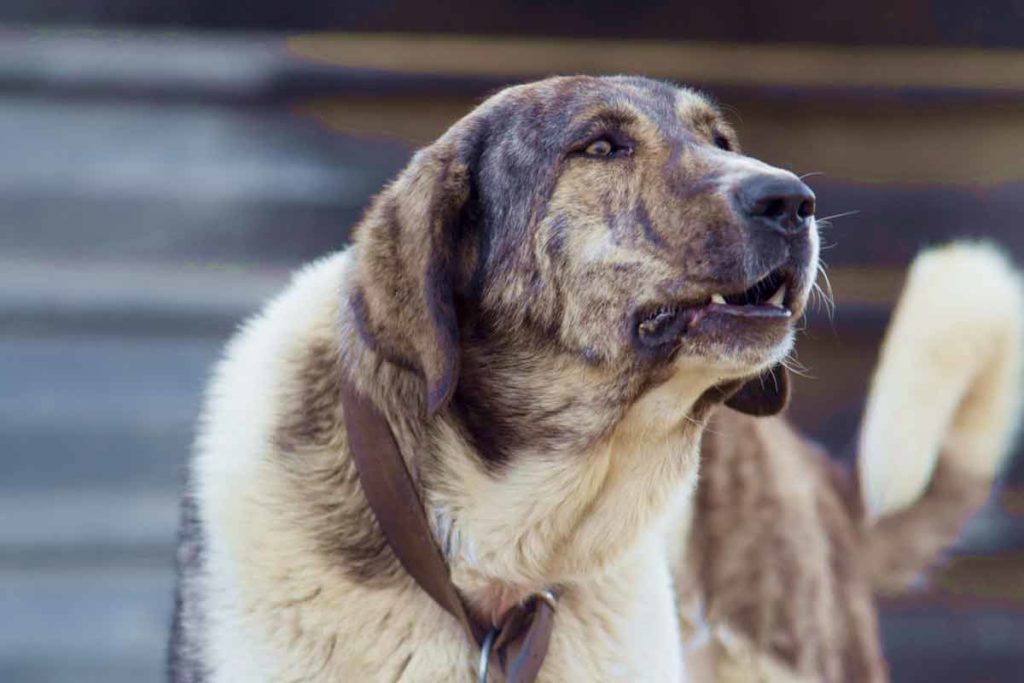
Orígenes y difusión de la raza: Originating from Spain, the Spanish Mastiff is closely linked to transhumance and Merino sheep, which it has accompanied since the times of the Mesta. It was used to defend livestock from predators like wolves during migrations and in various grazing areas. Currently, it continues to perform its ancestral role and is also used for guarding and defending estates, people, and properties in general.
Apariencia general y carácter
Descripción de conjunto: It is a large, hypermetric dog of medium proportions with a sub-longilinear structure. Well-proportioned, very powerful, and muscular with a compact skeleton. It has a large head and a semi-long coat. Proportionality and functional harmony are sought both at rest and in movement. Its bark is hoarse, deep, and loud, perceivable from a considerable distance.
Carácter y aptitud: It is a very intelligent dog, rustic, affectionate, gentle, and noble. It shows firmness towards predators and strangers, especially when defending estates or livestock. It is self-assured and conserves its strength due to its great power.
Morfología externa
Altura a los hombros: Males: minimum 77 cm, desirable over 80 cm. Females: minimum 72 cm, desirable over 75 cm.
Peso: No standard weight is specified in the document.
Cabeza: Large, strong, and trunk-pyramidal with wide bases. The cranio-facial lines are moderately divergent.
Cráneo: Wide and strong, with a subconvex profile. The width of the skull should be equal to or greater than its length. Accentuated frontal sinuses and a marked occipital crest.
Cara u hocico: Rectilinear profile, moderately rectangular seen from above, tapering towards the nose but maintaining significant width.
Nariz: Black, moist, large, and wide.
Labios o belfos: The upper lip covers the lower one extensively; the mucous membranes should be black.
Maxilares: Scissor bite with white, strong, and healthy teeth. Large and sharp canines, strong molars, and small incisors. All premolars are present.
Orejas: Medium-sized, drooping, triangular, flat, and set above eye level. In repose, they are close to the cheeks.
Cuello: Trunk-conical, wide, strong, muscular, and flexible, with a well-developed double dewlap.
Extremidades anteriores: Perfectly aligned, straight, and parallel when viewed from the front. Strong bones with powerful metacarpi.
Tronco: Rectangular, strong, and robust, indicating great power yet flexible and agile. Straight and horizontal top line with a well-marked withers.
Línea dorsolumbar: Straight, horizontal even in motion.
Grupa: Wide and strong, with an inclination of about 45° to the horizontal.
Flancos: Descended and wide.
Vientre: Moderately tucked up.
Órganos sexuales: Males must have two normally developed testicles fully descended into the scrotum.
Cola: Thick at the base, medium set, strong, flexible, and covered with longer hair than the rest of the body. In repose, it reaches down to the hocks.
Extremidades posteriores: Powerful and muscular, with appropriate angulations and correct alignment.
Pelo: Semi-long, dense, thick, and straight, with two types of hair: one for coverage and one for protection.
Color: Indeterminate, with uniform colors such as yellow, fawn, red, black, wolf gray, and deer-like, as well as combined colors like brindle, piebald, and spotted.
Defectos
Menores: Convex profiles of the muzzle.
Scissor bite.
Weak top line.
Weak metacarpi and metatarsi.
Mild shyness.
Severos: Fragile appearance.
Pointed muzzle.
Moderate superior prognathism.
Missing several premolars.
Excessive entropion or ectropion.
Tail resting on the croup.
Saddle-back line.
Incorrect limb alignment.
Cow hocks, lateral stepping.
Wavy or excessively long hair.
Unbalanced character.
Eliminatorios: Aggressiveness or extreme timidity.
Light eyes with depigmented nose or mucous membranes.
Split nose.
Inferior prognathism.
Excessively superior prognathism.
Light eyes.